Many business owners believe SEO is merely a technical background task or just a race to rank #1 on Google. In reality, half-hearted SEO efforts waste time and budget without delivering tangible impact on the company’s bottom line. High traffic means nothing if it doesn’t convert into sales.
In this guide, I will show you how to build an SEO ecosystem that not only makes your brand recognized but is also effective at capturing quality leads and consistently boosting revenue. We will break down the strategy from top to bottom, from market education to transactional execution.
Strategic Architecture: Why SEO is Core Business
Treating SEO as a mere operational expense is a fatal mistake. SEO for business should be positioned as a fundamental, compounding asset.
SEO as an Asset, Not a Cost
Unlike paid advertising (pay-per-click) that stops delivering results the moment your budget runs out, SEO is a compounding asset. Content optimized today will continue to drive organic traffic for years to come. You invest time and resources now to harvest free traffic in the future.
The Content Funnel Mastery
Corporate SEO cannot focus on just one type of keyword. You must map the customer journey from being unaware (Cold) to becoming a loyal customer (Loyal).
-
Cold: The audience realizes they have a problem but doesn’t know the solution.
-
Warm: The audience is researching solutions and comparing options.
-
Hot: The audience is ready to buy or use the service.
A well-designed pillar page and cluster content strategy will naturally guide users through these stages.
Building Brand Dominance (Top of Funnel – Awareness)
The main focus is ensuring your brand appears everywhere when potential customers search for general solutions. You want to be recognized as the authority in your industry.
Topical Authority & Cluster Strategy
Do not create content randomly. You need to build a “Pillar Page” that covers a broad topic in depth, surrounded by “Cluster Content” that addresses specific sub-topics.
-
Pillar Page: “The Complete Guide to Corporate Digital Marketing”.
-
Cluster Content: “Local SEO Tips”, “Social Media Content Strategy”, “How to Start Google Ads”.
Use strategic internal linking to distribute Link Juice from cluster articles to the pillar page, strengthening your site’s relevance in Google’s eyes.
Optimizing E-E-A-T (Detail)
Google assesses brand credibility through Experience, Expertise, Authoritativeness, and Trustworthiness.
-
Experience: Show real-world usage evidence with case studies and internal data.
-
Expertise: Ensure author profiles list their qualifications.
-
Authoritativeness: Get mentions from industry news sites or trusted journals.
-
Trustworthiness: Ensure your website is secure (SSL), has a privacy policy, and solid Google Maps reviews.
Digital PR & Link Building
Quality links are a primary signal of authority. Use Guest Posting strategies on relevant sites or employ the “Skyscraper” technique. Find competitor content with many backlinks, then create content that is much deeper, more informative, and visual than theirs to claim that position.
Lead Generation Strategy (Middle of Funnel – Consideration)
High traffic is useless if visitors leave immediately. You need a capture strategy to obtain contact information from an audience that is interested but not yet ready to buy.
The Power of Educational Search Intent
Answer specific audience pain points through “How-to” guides. Additionally, use comparison keywords to capture an audience comparing options.
-
Example: “Software A vs Software B” or “SEO Agency vs In-house Employee”.
Lead Capture Optimization
Turn readers into leads by offering added value.
-
In-depth Guides: Create whitepapers or industry reports that can be downloaded (lead magnets).
-
Interactive Tools: Use ROI calculators or brand personality quizzes that require them to enter an email to see results.
Optimizing UX (User Experience) for Conversion
-
Mobile-First Indexing: Ensure a seamless mobile experience, as most searches occur on phones.
-
Core Web Vitals: Optimize page speed (LCP, FID, CLS) to reduce Bounce Rate. Comfortable visitors are more likely to fill out forms.
Marketing Automation Integration
Connect website forms directly to a CRM like HubSpot or Salesforce. This ensures your sales team can immediately follow up on incoming leads without delay.
Monetization & Revenue (Bottom of Funnel – Conversion)
The final step is ensuring SEO directly impacts the company’s bottom line. The focus here is closing sales with keywords that have high buying intent.
Transactional Keyword Dominance
Optimize service or product pages for specific keywords like “Price”, “Buy”, “Service”, or “Best”. Use a Product-Led Content strategy, where you explain how your product solves problems directly within blog content.
Social Proof Integration
Build instant trust by displaying video testimonials or real-time review widgets indexed by Google using Schema Markup.
CRO (Conversion Rate Optimization) via SEO Data
Use data from SEO to A/B test headlines and CTA buttons. Analyze heatmaps to see where the audience stops reading and improve the conversion flow.
Analytics, Reporting, & Scalability
SEO is an investment that must be measured. You must prove that these efforts are actually generating revenue, not just traffic numbers.
Advanced Tracking
-
Setting Conversion Tracking: Use Google Analytics 4 (GA4) to track leads and sales from organic channels.
-
Google Search Console: Connect it to a business dashboard to view keyword performance in real-time.
Attribution Modeling
Understand that SEO is often the first touchpoint (first-touch) before a customer finally buys through ads or direct channels. Do not judge SEO solely based on the last conversion.
Continuous Optimization
-
Content Audit: Conduct routine checks. Update old content, merge similar articles, or delete irrelevant content (content pruning).
-
Competitor Monitoring: Track competitor keyword movements monthly to anticipate trend changes.
Conclusion & Execution Roadmap
Building a corporate SEO strategy that generates revenue is not an overnight task. It is a synergy between educational content, robust website technicals, and a deep understanding of consumer behavior.
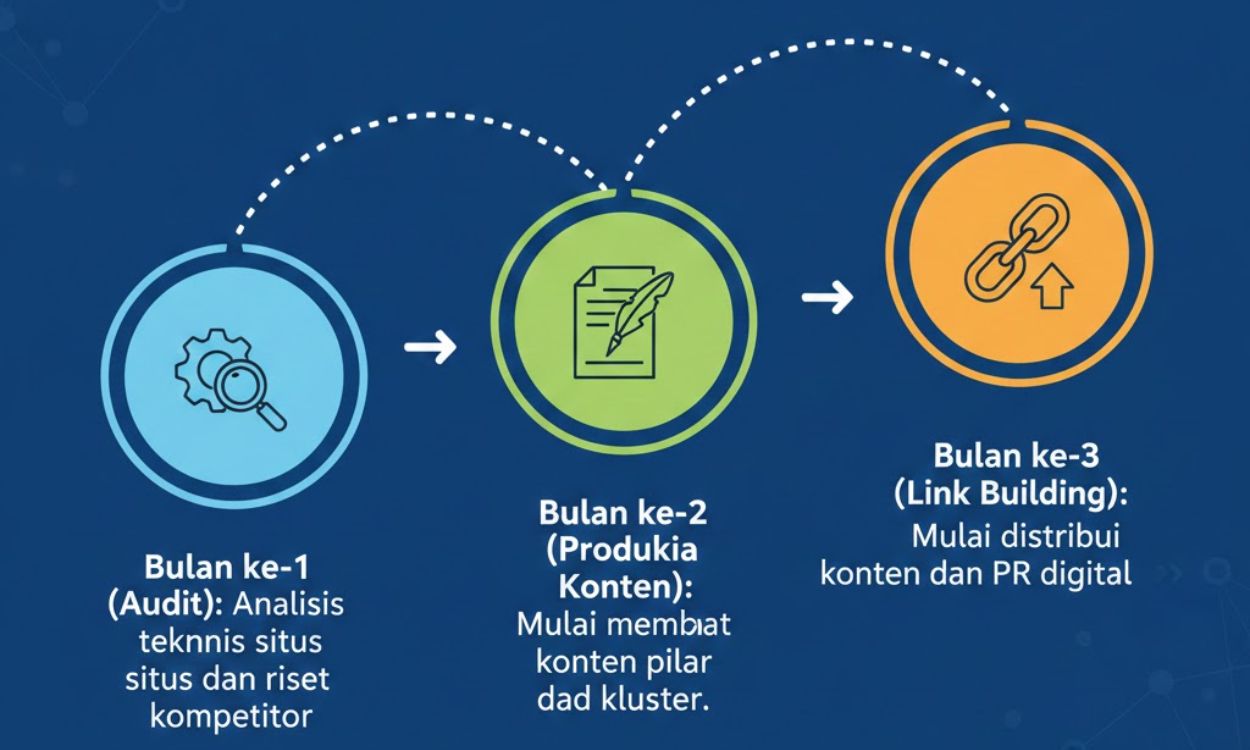
Here is a step-by-step guide to get started:
-
Month 1 (Audit): Analyze site technicals and competitor research.
-
Month 2 (Content Production): Begin creating pillar and cluster content.
-
Month 3 (Link Building): Start content distribution and digital PR.
SEO is not a standalone department. Ensure your sales team uses your content as a sales enablement tool to answer prospective client questions before they call.
If you want to professionally optimize your company’s website potential, you can consult further via pusatoptimasi.id to get a custom strategy tailored to your industry.
FAQ Seo Corporate Strategy
1. How long does it take for SEO to generate revenue?
Generally, significant results begin to appear in 6 to 12 months. However, this heavily depends on the industry’s competitiveness and the quality of consistent optimization performed.
2. Is SEO enough to increase branding?
SEO greatly helps with visibility, but strong branding also needs to be supported by good service, consistent visual design, and a social media presence.
3. Which is more important: Traffic or Leads?
In a business context, leads are much more important. 1,000 visitors who just read and leave are worth less than 10 people contacting your sales team to ask about pricing.
4. Why does a company need help from SEO experts?
Google’s algorithm changes thousands of times a year. SEO experts ensure the company keeps up with the latest standards (such as E-E-A-T updates) and avoids penalties that could harm the business.
5. Is the pillar content strategy effective for all industries?
Yes. Pillar content helps organize information on your site, makes it easier for Google to understand your business’s main topic, and increases the chances of ranking for many keywords simultaneously.